
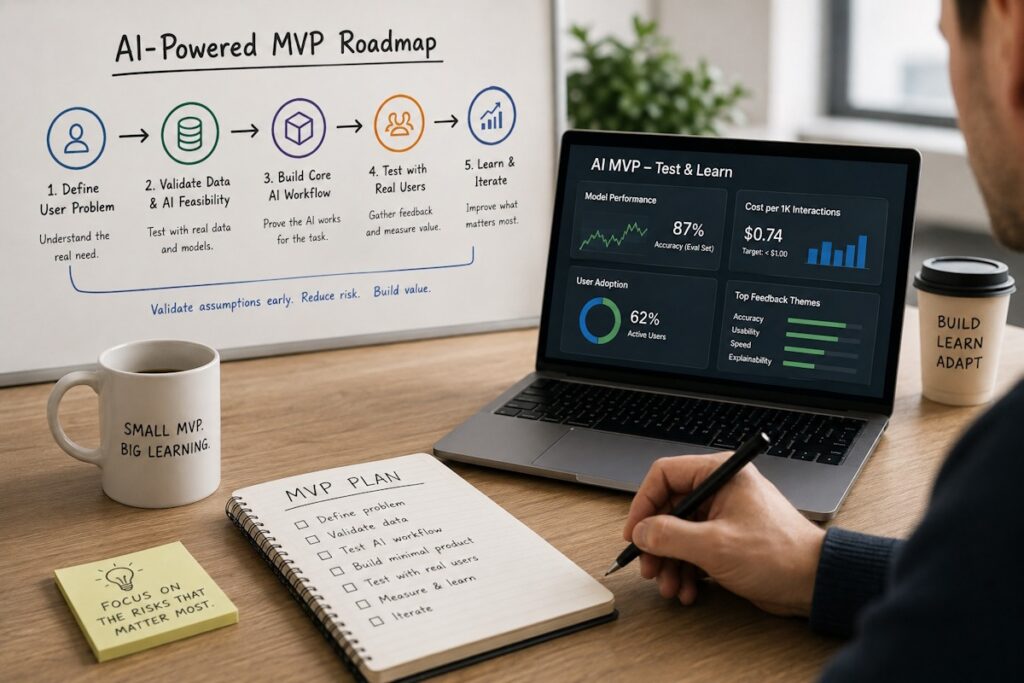
Building a minimum viable product is usually about reducing scope. A team identifies the core problem, chooses the smallest feature set that can solve it, builds a working version, and puts it in front of users. When AI sits at the center of the product, that familiar process becomes more complicated because the product depends on something that does not always behave predictably.
An AI-based MVP has to answer two questions at the same time. The first is whether people actually want the product. The second is whether the AI can perform the required task well enough to make that product useful. A startup can prove one and still fail on the other, which is why simply adding an AI API to a conventional MVP plan is rarely enough.
The better approach is to treat product value and AI feasibility as connected experiments. Founders need to test both early, while the product is still small enough to change direction without carrying months of engineering work with it.
Start With the User Problem, Not the Model
AI products often begin with a technology conversation. A founder sees what a new model can do and starts thinking about applications for it. That can produce interesting ideas, but it can also lead to a product that demonstrates impressive technology without solving a problem customers consider important enough to pay for.
A better starting point is the task the customer struggles with. Perhaps insurance teams spend hours reviewing documents, recruiters repeatedly screen similar applications, or support agents search through several systems before answering a customer. Once that problem is clear, the team can decide whether AI is actually a sensible way to address it.
This distinction matters when defining the MVP. Instead of asking, “Which AI features should we build?” the team can ask, “What is the smallest experience that proves we can improve this task?” That question keeps the MVP tied to customer value rather than the novelty of the underlying technology.
Identify the AI Assumption That Could Break the Product
Every MVP contains assumptions, but AI products tend to carry technical assumptions that are easy to overlook during early planning. A team may assume that a model will understand its documents, produce acceptable answers, work with industry terminology, respond quickly enough, or operate at a cost that makes the business model possible.
Those assumptions need to become testable questions. If an AI accounting product depends on extracting accurate information from invoices, extraction quality may be the first thing worth testing. There is little value in building dashboards, account management, reporting, and polished workflows if the core system cannot reliably understand the source documents.
Founders who are unsure how to assess model suitability, data requirements, privacy constraints, or technical architecture may use experienced AI consulting services during this stage. The purpose of that assessment should be to expose technical risks before they become expensive product decisions, not to plan every component of the eventual platform.
Prove the AI Workflow Before Building the Whole Application
A common mistake is building the surrounding software before proving that the AI workflow works. Teams create user accounts, dashboards, admin panels, billing systems, notifications, settings, and other conventional features while the hardest part of the product remains uncertain.
For an AI-dependent MVP, the order often needs to be reversed. Test the uncertain intelligence first. A simple internal prototype that accepts real input and produces a useful output can answer more important questions than a polished interface built around an untested model.
Suppose a startup wants to create an AI assistant that summarizes legal documents and identifies areas requiring attention. Before building a full SaaS platform, the team could test a limited set of documents with several model approaches and compare the results against expert reviews. That exercise may reveal accuracy gaps, input limitations, cost issues, or situations where human review is unavoidable.
Decide What “Good Enough” Means Before Testing
AI output cannot be judged only as working or broken. Two people may look at the same response and disagree about whether it is useful. Without clear criteria, teams can spend weeks adjusting prompts or changing models without knowing whether the product is actually getting closer to something customers can rely on.
Define acceptable performance before testing. The measurement will depend on the product. A recommendation tool might be judged by relevance, while a document extraction system could be measured by field accuracy. An AI writing assistant may need user acceptance rates, and a support assistant could be evaluated by how often agents use its suggested answers without major edits.
The MVP does not need perfect model performance. It needs performance that is good enough for the specific use case and risk level. A minor mistake in an entertainment recommendation has very different consequences from an incorrect output in a financial, legal, or medical workflow.
Your Data May Matter More Than Your Model
Teams sometimes spend too much time choosing between models while paying too little attention to the data entering them. If the product depends on incomplete, inconsistent, poorly structured, or inaccessible information, changing the model may not solve the underlying problem.
Data questions should appear early in MVP planning. What information does the product require? Where does it come from? Can the startup legally use it? How consistent is it? Does it contain enough examples of difficult cases? Will customers need to connect their own systems before the product can provide useful results?
These questions can change the shape of the MVP. A product that eventually needs several enterprise data sources may begin with manual uploads or a single connector. This keeps the initial build manageable while still allowing the team to test whether the AI output creates enough value to justify deeper data work later.
Keep the First Use Case Narrow
General-purpose AI sounds attractive because it suggests a larger market. In practice, broad scope makes an early product much harder to evaluate. If the MVP supports ten workflows across five customer types, every poor result creates a new question about whether the problem comes from the model, the workflow, the data, or the target audience.
A narrow use case provides cleaner evidence. An AI assistant designed specifically to classify a certain type of support request can be tested against a clear dataset and a clear user need. The team can measure performance, observe user behavior, and understand failure cases without dealing with dozens of unrelated variables.
Narrow scope does not mean the business has to stay narrow. It means the startup earns the right to expand by first proving that one meaningful workflow works. Once the team understands that workflow deeply, adding related capabilities becomes a more informed decision.
Design for AI Failure, Not Just AI Success
Conventional software usually follows predefined rules. AI systems can produce responses that are incomplete, irrelevant, inconsistent, or confidently wrong. An MVP that assumes every AI response will be usable is not testing the real product experience.
The team needs to decide what happens when the AI is uncertain. That could mean asking the user for more information, showing the source material behind an answer, routing a task for human review, allowing users to edit the output, or refusing to provide a result when confidence is too low.
These fallback paths are part of the product, not temporary technical patches. In many AI applications, the quality of the experience depends as much on how failure is handled as on how the model behaves when everything goes well. Early users can provide useful evidence about which mistakes they tolerate and which ones immediately damage trust.
Track the Cost of Every AI Interaction
A conventional MVP may have relatively predictable infrastructure costs. AI products can introduce variable expenses tied to model usage, data processing, storage, third-party APIs, retrieval systems, and repeated model calls. A feature that looks affordable with twenty test users can become expensive when thousands of customers begin using it every day.
Cost therefore needs to be part of validation. Teams should estimate how many AI interactions a typical user creates, how much each workflow costs, whether prompts or context become larger over time, and how those costs compare with the expected price of the product.
This can also influence product design. Not every action needs the most capable model available. Some tasks may work well with smaller models, deterministic code, cached results, or traditional search. The goal is not to use AI everywhere. It is to use it where the extra capability creates enough value to justify the cost.
Build the Team Around Uncertainty
The people building an AI MVP need to be comfortable with experimentation. Requirements may change after model tests. A workflow that looked simple on paper may perform poorly with real data, while another approach may produce better results with less engineering work.
For that reason, startups looking to hire MVP developers should consider experience with iterative product development alongside coding ability. Developers working on an early AI product need to question assumptions, create small experiments, compare technical options, and avoid treating the first architecture as permanent.
The team should also be able to distinguish between problems that require AI and those that are better solved with ordinary software. A product becomes harder to maintain when every workflow is forced through a model, especially when straightforward business rules could produce faster, cheaper, and more predictable results.
Put the MVP in Front of Real Users Early
Internal AI testing can reveal whether a model performs a task, but it cannot tell a startup whether customers will trust or adopt the product. Real users bring context that test datasets cannot reproduce. They phrase requests differently, upload unexpected files, misunderstand features, challenge outputs, and use the product in ways the team did not anticipate.
Early testing should observe behavior rather than relying only on opinions. If users say they like an AI feature but repeatedly verify every output manually, the product may not be saving as much time as expected. If they ignore an advanced capability but repeatedly use a simple one, that behavior can guide the next development cycle.
User feedback is particularly valuable when paired with model performance data. The startup can see not only where the AI fails technically, but which failures actually matter to customers. That distinction prevents teams from spending too much time improving edge cases that have little effect on the product’s usefulness.
Do Not Confuse a Demo With an MVP
AI makes it surprisingly easy to create impressive demonstrations. A carefully selected prompt and a few successful examples can make an idea look ready long before it has faced real-world inputs. This creates a dangerous gap between showing that something is possible and proving that it works as a product.
A useful MVP needs more than a successful demonstration. It needs repeatable behavior across realistic inputs, a workflow customers understand, acceptable response times, manageable costs, sensible failure handling, and enough customer value to encourage continued use.
The distinction becomes especially important when talking to investors, partners, or early customers. A demo proves that the concept can work under certain conditions. An MVP should begin proving that the concept can survive outside those conditions.
Let Evidence Decide What Gets Built Next
Once early users begin interacting with the product, the startup will have many possible directions. Customers may request new features, developers may identify technical improvements, and founders may see opportunities to broaden the AI capability. Trying to pursue all of them can quickly turn a focused MVP into a complicated platform.
The next development decisions should come from the risks the startup has already reduced and the ones that remain. If customers clearly value the workflow but model costs are too high, cost reduction deserves attention. If the model performs well but users do not trust the results, explainability and review controls may matter more than adding another feature.
This is where an AI MVP does its most valuable work. It turns assumptions into evidence and gives the team a clearer basis for deciding where the next month of engineering effort should go.
Build Enough AI to Learn What Matters
An AI-dependent MVP should not attempt to prove that a startup can build a sophisticated AI system. It should prove that AI can solve a specific customer problem reliably enough, affordably enough, and clearly enough to support a viable product.
That requires discipline. Test the uncertain AI workflow early, define acceptable performance, understand the data, keep the first use case narrow, measure operating costs, and expose the product to real users before expanding the scope.
AI gives startups access to capabilities that once required much larger technical teams and budgets. The startups that benefit most will not necessarily be the ones that put the most AI into their first product. They will be the ones that use an MVP to discover exactly where AI earns its place.
——————————————————
Author Bio: Arjun is a business growth strategist at WeblineIndia, a software development company. Apart from building long-term relationships with customers and boosting business revenue, he is also interested in sharing his knowledge of various technologies through successful blog posts and articles.