
SaaS products are no longer limited to desktop dashboards.
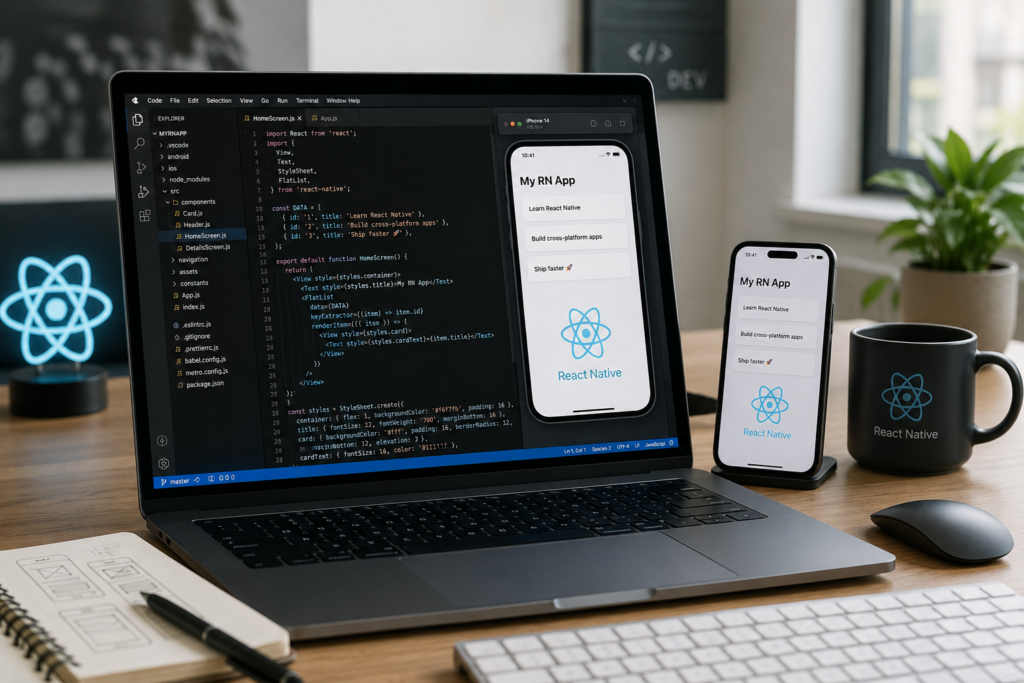
Users now expect to access important parts of a SaaS product from their phones. They want alerts, approvals, quick status checks, account updates, reports, messages, reminders, and task actions without always opening a laptop. In many cases, mobile is not a secondary channel anymore. It is part of the core product experience.
That creates a challenge for SaaS teams.
They need mobile apps that work across iOS and Android, stay aligned with the web product, support frequent updates, and remain easy to maintain as the SaaS platform grows. Building and maintaining two completely separate native apps can be a heavy commitment, especially when the roadmap changes often.
React Native can be a practical solution.
It gives SaaS teams a way to build mobile experiences with a shared development approach while still supporting native mobile behavior where it matters.
SaaS mobile apps have different needs
A SaaS mobile app is usually not just a smaller version of the web app.
Mobile users often want different things. They may need quick approvals, real-time alerts, lightweight dashboards, team messages, task updates, or simplified workflows. The full desktop product may be too complex for a phone screen.
That means SaaS mobile design should be focused.
React Native supports this because teams can build mobile-specific experiences while still sharing patterns and logic across platforms. The app can prioritize the workflows that make sense on mobile instead of trying to copy every web feature.
A good SaaS mobile app helps users act faster, not do everything.
React Native supports frequent product updates
SaaS products change constantly.
Features evolve. Dashboards are adjusted. Plans change. Permissions are refined. User roles expand. New integrations are added. Customer feedback shapes the roadmap. A mobile app connected to a SaaS product needs to keep up with that pace.
React Native can help because shared development reduces some of the duplicated effort across iOS and Android. When the product team improves a workflow, updates a component, or changes a dashboard card, that improvement can often move across platforms more efficiently.
This is why React Native SaaS app development makes sense for products that need regular iteration. The app is not frozen after launch. It has to keep evolving with the platform.
Dashboards need mobile-first thinking
Many SaaS apps include dashboards, but not every dashboard belongs on a phone exactly as it appears on desktop.
Mobile dashboards should be selective. They should show what users need quickly: alerts, key metrics, task summaries, account health, recent activity, or urgent actions. A dense analytics screen that works on a large monitor may be frustrating on mobile.
React Native allows teams to build focused dashboard components such as cards, lists, filters, charts, status indicators, and notification panels. These elements can be reused across the app and refined over time.
The goal is not to show more data. The goal is to show the right data at the right moment.
Notifications are central to mobile SaaS
Mobile SaaS apps often depend on notifications.
A user may need to know when a task is assigned, a payment fails, a report is ready, a teammate comments, a customer responds, or an approval is needed. These updates can make the mobile app genuinely useful.
But notifications should be handled carefully.
Too many alerts create noise. Poorly timed notifications reduce trust. A good notification strategy focuses on relevance and action. Users should feel that notifications help them stay on top of important work, not that the app is trying to pull them back constantly.
React Native can support notification workflows, but the product strategy should define what deserves attention.
Offline access can improve reliability
Many SaaS users work outside perfect network conditions.
Sales reps travel. Field teams visit customers. Managers check dashboards on the move. Support teams may need information during calls. If the app fails completely when connectivity weakens, users lose confidence.
React Native can support cached data, offline views, saved actions, and sync-aware workflows. SaaS teams should decide which parts of the app need offline support and how the app should communicate sync status.
Not every SaaS app needs full offline functionality, but many benefit from basic resilience.
Users should not feel helpless when the network is unstable.
Security and permissions matter
SaaS apps often contain sensitive business data.
That makes security and permissions essential. Mobile users may access customer records, billing details, internal reports, documents, messages, and operational workflows. Not every user should see or do the same things.
React Native apps need strong authentication, secure API communication, role-based access, and careful handling of stored data. The mobile interface should also make permissions clear. Users should only see actions that make sense for their role.
This is one area where SaaS mobile apps need more discipline than simple consumer apps.
The right team helps keep mobile aligned with SaaS growth
A SaaS mobile app is connected to a living platform.
That means the mobile team needs to understand product changes, backend APIs, user roles, analytics, onboarding, notifications, and release cycles. This is where remote React Native engineers can help SaaS companies extend mobile capability without forcing every feature into separate iOS and Android tracks.
Good engineers help keep the mobile app aligned with the SaaS roadmap. They also know how to balance shared code with platform-specific behavior where needed.
That matters because mobile SaaS apps need to improve continuously.
Final Thoughts
React Native makes sense for mobile-first SaaS products because it supports cross-platform access, faster iteration, reusable components, notifications, dashboards, and workflows that can evolve with the product.
It is not about copying the desktop app into mobile form. It is about giving users the mobile actions they actually need.
For SaaS businesses that want mobile experiences to be useful, maintainable, and aligned with ongoing product growth, React Native remains a practical and flexible choice.