
Talent screening has been broken for decades.
Recruiters spend hours cold-calling candidates. They juggle impossible schedules across time zones. They ask the same repetitive questions dozens of times. They struggle to maintain consistent evaluation standards while trying to eliminate bias.
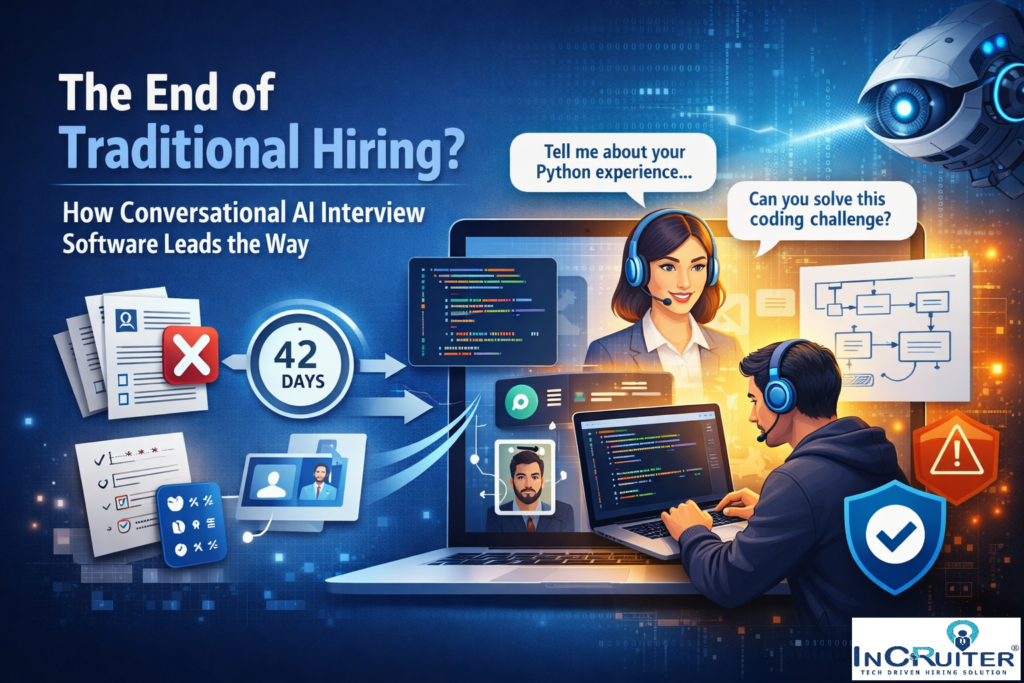
The result? 42-day average time-to-hire. 60% candidate drop-off rates. Missed top talent. Frustrated hiring teams.
Traditional screening tools have tried to address this. But recording candidates answering pre-set questions doesn’t solve the core problem. Neither do multiple-choice technical tests that measure memorization instead of actual coding ability.
The solution isn’t better scheduling tools or longer questionnaires. It’s fundamentally different technology: AI interview software powered by conversational AI.
What Makes Conversational AI Interview Software Actually Different?
Most hiring platforms automate tasks. They send calendar invites. They play pre-recorded questions. They score yes/no answers.
Conversational AI does something fundamentally different. It holds real, adaptive dialogues with candidates.
Here’s how traditional tools work:
Candidate logs in. System plays Question 1. Candidate records answer. System plays Question 2. Repeat until done. No follow-up. No depth. No adaptation.
Here’s how conversational AI works:
The AI interviewer asks the opening question. Candidate responds. AI analyzes response in real time. The conversational AI bot asks intelligent follow-up questions based on what the candidate just said. Conversation adapts dynamically.
Example:
Candidate mentions Python experience.
Traditional tool: Moves to the next pre-scripted question about project management.
Conversational AI: “You mentioned Python. Which frameworks have you used? Tell me about a challenging problem you solved with Django. How did you optimize that database query?”
The AI probes deeper where it matters. It skips surface-level areas. It builds context throughout the conversation instead of treating each question as isolated.
This isn’t a chatbot following scripts. It’s natural language processing that understands responses, identifies gaps, and asks targeted follow-ups without human intervention.
The Coding Assessment Problem Nobody Solved (Until Now)
Most technical hiring platforms test candidates with multiple-choice questions.
The MCQ approach has fatal flaws:
Candidates can Google answers in another tab. Copy-paste from Stack Overflow. Memorize common patterns without understanding. Pass tests without writing a single line of actual code.
MCQs test theoretical knowledge. They don’t test whether someone can actually build software.
The real question: Can this candidate solve a coding problem from scratch while explaining their thinking?
This is why online coding assessment with integrated code compilers represents the biggest differentiator in AI interview software today.
How Coding Assessment tool actually works?
The AI-driven coding assessment tool presents a coding challenge. The candidate writes code in the system’s built-in code editor. The integrated compiler supports 40+ programming languages (Python, Java, JavaScript, C++, Go, Rust, and more). The candidate runs their code in real time to test it. They use the digital whiteboard to diagram system architecture or explain algorithms.
Meanwhile, the AI evaluates:
- Code quality: Logic, efficiency, structure
- Problem-solving approach: How they break down complex problems
- Communication skills: How they explain their thought process
- Debugging ability: How they identify and fix errors
This tests actual coding ability. Not memorization. Not Google skills. Real competency.
Other platforms ask: “What does this code snippet do?”
Conversational AI with live coding says: “Build a function that does X. Optimize it. Now explain why you chose this approach.”
The difference is enormous.
Ensuring Interview Integrity with AI Proctoring Technology
As remote interviews became standard, a new problem emerged: fraud.
Proxy candidates are taking interviews for others. Screen-switching to search for answers. Background voices coaching responses. Multiple people collaborating off-camera.
By late 2025, candidates could use AI voice synthesis tools and deepfake technology to fake entire interviews. The cost? Under $5. Technical expertise required? None.
This is why cheat-proof screening became non-negotiable for enterprise hiring.
AI proctoring technology integrates directly into conversational AI interview software to detect:
Proxy attempts: Multiple faces detected, face-swapping, AI to answer the question
Background assistance: Additional voices detected, unusual audio patterns
Screen activity: Tab switching, copy-pasting, unauthorized applications running
Behavioral anomalies: Eye movement patterns suggesting reading from another source
When suspicious activity occurs, the system flags it in real time and logs detailed evidence in the final report.
This creates audit-ready hiring processes. Every interview has a verifiable integrity score. Recruiters can trust that candidate performance reflects actual ability, not external help.
The combination of Conversational AI (for evaluation depth) plus AI proctoring (for security) delivers something neither technology achieves alone: trustworthy, scalable technical screening.
The Actual Workflow (Simpler Than You Think)
Traditional hiring involves 15 manual steps between CV submission and the first interview. With Conversational AI interview software, the workflow collapses to seven automated stages:
- AI Resume Screening
An AI resume screening tool that parses thousands of resumes against job requirements. Ranks candidates by match quality. Flags top prospects instantly.
- Interview setup
AI generates role-specific screening questions based on the JD. Technical roles get coding challenges. Sales roles get scenario-based questions. No template hunting required.
- Automated Invitations
The platform sends interview invitations to shortlisted candidates. Email includes a private access link. No scheduling coordination needed.
- Conversational AI Interview
The candidate connects with the Conversational AI interviewer, who asks an opening question. Adapts follow-ups based on responses. For technical roles, presents coding challenges with live compiler access. AI proctoring monitors throughout.
- Instant Feedback Reports
Interview ends. The system generates a comprehensive evaluation report with a full transcript, sentiment analysis, skill ratings, proctoring flags, and a hiring recommendation. Recruiter reviews insights, not raw video.
No phone tag. No calendar conflicts. No inconsistent evaluations. No scheduling coordinators needed.
Real Business Impact: Why Companies Switch?
Organizations implementing Conversational AI interview software report consistent outcomes:
- Scale without headcount: Interview 1,000 candidates simultaneously. AI capacity isn’t limited by human interviewer availability.
- Global accessibility: Candidates in Tokyo, Berlin, and San Francisco all interview at convenient times. No recruiter works 18-hour days.
- Evaluation depth: Adaptive questioning reveals competency levels that static tests miss. Follow-up questions probe where it matters.
- Speed: First-round screening completes in hours, not weeks. Recruiters review structured reports instead of conducting repetitive calls.
- Inclusivity: Multilingual support (English, Hindi, Spanish, regional dialects) expands talent pools. Every candidate engages in their preferred language.
- Consistency: Every candidate gets evaluated using the same standards. No variance based on interviewer mood or experience level.
The companies growing fastest aren’t the ones hiring more recruiters. They’re the ones that decoupled interview capacity from headcount.
The Shift from Screening to Intelligence
The future of technical hiring isn’t about conducting more interviews faster.
It’s about converting every conversation into structured intelligence that improves hiring decisions.
Traditional screening generated unstructured data. Handwritten notes. Scattered impressions. Inconsistent formats.
Conversational AI generates structured intelligence. Transcripts. Competency scores. Behavioral patterns. Predictive fit analysis.
This data doesn’t just evaluate individual candidates. It identifies which questions predict successful hires. It flags where evaluation standards drift. It benchmarks talent globally.
Screening evolves from qualification checking to continuous learning systems that get smarter with every interview.
Platforms like InCruiter demonstrate this shift through Full-Stack Video Interview Software, where Agentic AI & Conversational AI not only automate each stage of the talent screening process but also integrate to form unified intelligence layers. Technology doesn’t replace human judgment. It amplifies it by handling repetitive screening while delivering evidence-based insights for final decisions.
The organizations adopting this approach aren’t experimenting. They’re gaining a sustained competitive advantage in talent acquisition.
The question isn’t whether AI will conduct technical interviews. It’s whether your hiring process will adapt before your competitors do.