
Fitness apps used to be fairly simple. They counted steps, estimated calories, maybe tracked a run on a map. Useful enough but not particularly intelligent about what you actually needed on any given day.
Wearables changed that. Not overnight and not perfectly, but the combination of a device that sits on your wrist collecting data throughout the day and an app that can actually do something with that data has moved things somewhere more interesting.
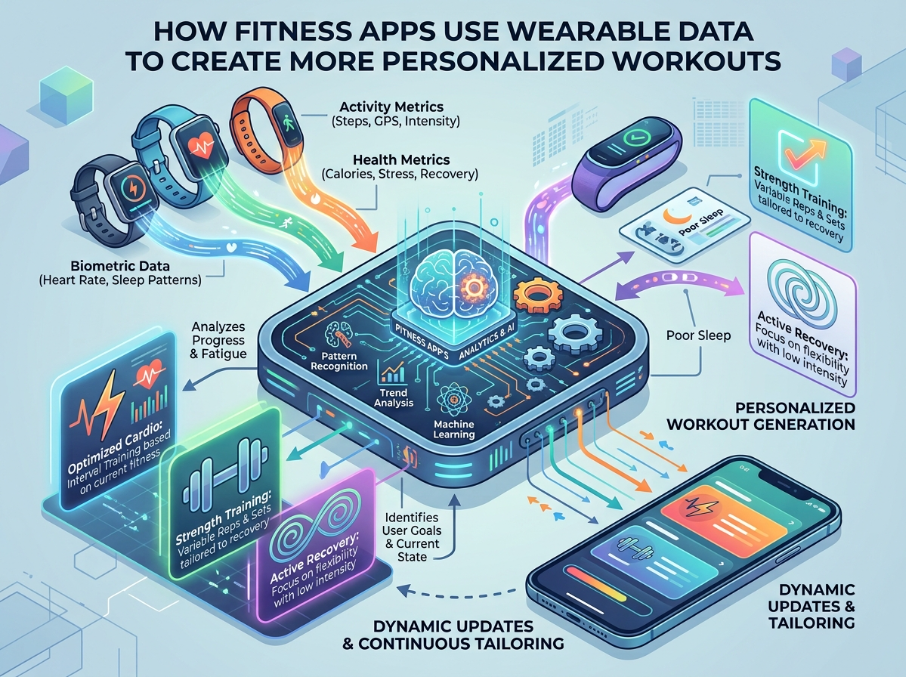
The workout you get suggested on a Monday morning after a poor night’s sleep and a hard session on Sunday can now be genuinely different from the one you get after a well-rested recovery weekend. That responsiveness is what people mean when they talk about personalised fitness.
The Data That Actually Matters
These aspects matter the most when you are on your fitness journey; let’s take a look:
Your Heart Rate
It is the most useful signal during exercise. A wearable tracking your heart rate through a workout gives the app a real-time picture of how hard your body is working, not just how hard the session looked on paper. Two people doing the same workout can have very different heart rate responses depending on their fitness level, how recovered they are, and a dozen other factors.
Your Sleep Data
Sleep data is the one that surprises people most when they first pay attention to it. Most wearables track not just how long you slept but how restful it was. It does so by keeping track of your resting heart rate overnight and various recovery indicators.
Your Daily Activity Levels
Daily activity levels matter too in ways that are easy to overlook. Someone who has spent the day on their feet, arrives at an evening workout in a different state than someone who sat at a desk for eight hours. Steps alone do not capture all of this, but they provide useful context that changes what a sensible workout recommendation looks like.
Previous Workout Performance
Yes, that performance feeds into it as well. How your heart rate responded to last week’s session, how long it took to recover, whether your pace or output improved or dropped, all of it builds a picture over time that allows the app to track genuine progress rather than just assumed progress.
With the right fitness app development company by your side, you can easily build an app that notices the smallest changes. It will know when you have had three consecutive nights of broken sleep. Accordingly, it will suggest you take an easier day rather than pushing another intense session is doing something that a pre-written training plan simply cannot do. The plan does not know what your Tuesday night looked like. The app, with the wearable data, does.
What the App Actually Does With It
Some people always go hard regardless of how they feel. Others consistently underestimate what they can handle. Having an app that looks at the data and suggests a realistic level cuts through both tendencies.
Adjusting Workout Intensity
The most direct use is adjusting intensity. If the data suggests you are recovering well and your recent sessions have been comfortably within your capacity, the app might push you toward something more demanding. If the opposite is true, it pulls back. This is a pretty simple concept but it is genuinely useful because most people are not good at making this call themselves.
Adapting Exercise Selection
Exercise selection can also adapt. Someone training primarily for endurance will see different sessions from someone focused on building strength, and both will see sessions that shift as their fitness evolves. A beginner doing their first few weeks of running gets different recommendations from the same person eight weeks later when their heart rate data shows meaningful adaptation.
Making Progress Easier to See
Progress tracking is probably the most motivating use of wearable data for a lot of people. Day to day it can be hard to feel like you are improving. You have a good session, then a mediocre one, then a good one again. Zooming out to look at how your heart rate response to the same level of effort has changed over several months is often more revealing than any single workout. Seeing that your resting heart rate has dropped is concrete evidence that something is working.
Knowing When to Rest
Rest and recovery suggestions are the underappreciated one. Apps that use wearable data well will sometimes tell you the most useful thing you can do today is not work out. Not because they are being cautious but because the data shows that another intense session right now is likely to work against you rather than for you. People who tend to overtrain often benefit from this more than anything else the app can do.
Where It Does Not Work Perfectly
Wearable sensors are not medical instruments and the data they produce is not perfectly accurate. Heart rate readings can drift during certain types of exercise. Sleep staging is an estimate rather than a measurement. The numbers should be treated as useful indicators rather than ground truth.
This matters because an on-demand personal trainer app making recommendations based on wearable data is only as good as the data it receives. If your device consistently under-reads your heart rate during high intensity intervals, the intensity recommendations it generates will be off. Most of the time this is a small effect and the overall direction of the recommendations is still useful.
Privacy is the other thing worth focusing. Detailed health and activity data is genuinely personal information and it deserves to be treated that way. Before connecting a wearable to a fitness app it is worth understanding what data is being collected and who it might be shared with. It’s actually the case with using any app.
The personalisation that wearable data makes possible is only useful when it is done well. The workout that actually fits where you are today is more valuable than the workout that works on the basis of assumptions.